
A Legacy of Science. More Than 150 Years of Permanent Hair Removal.
Electrolysis is not a passing beauty trend or a recently developed cosmetic treatment. It is a medically established procedure with a history spanning more than 150 years, continually refined through scientific research, technological innovation, and clinical practice. Today, electrolysis remains the only method recognized by the U.S. Food and Drug Administration (FDA) for permanent hair removal.
1834
The Science Begins
British scientist Michael Faraday published what became known as Faraday's Laws of Electrolysis, explaining how electrical current produces chemical reactions. His groundbreaking research established the scientific principles that would later make permanent hair removal through electrolysis possible.
1875
The First Permanent Hair Removal Treatment
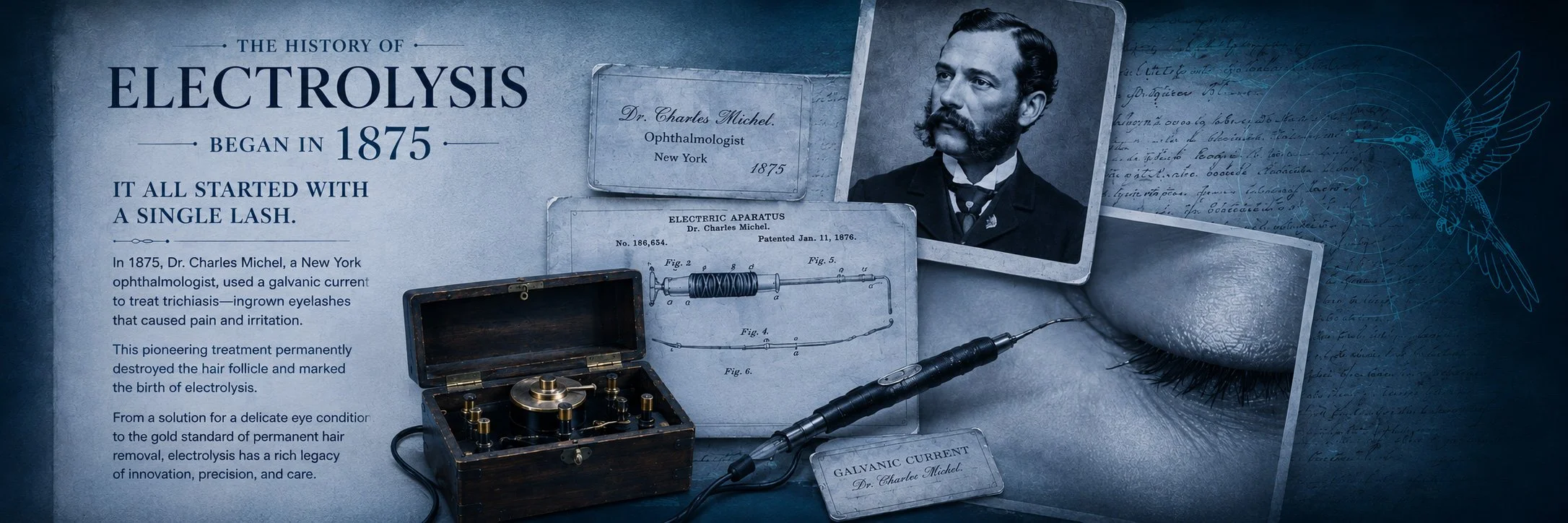
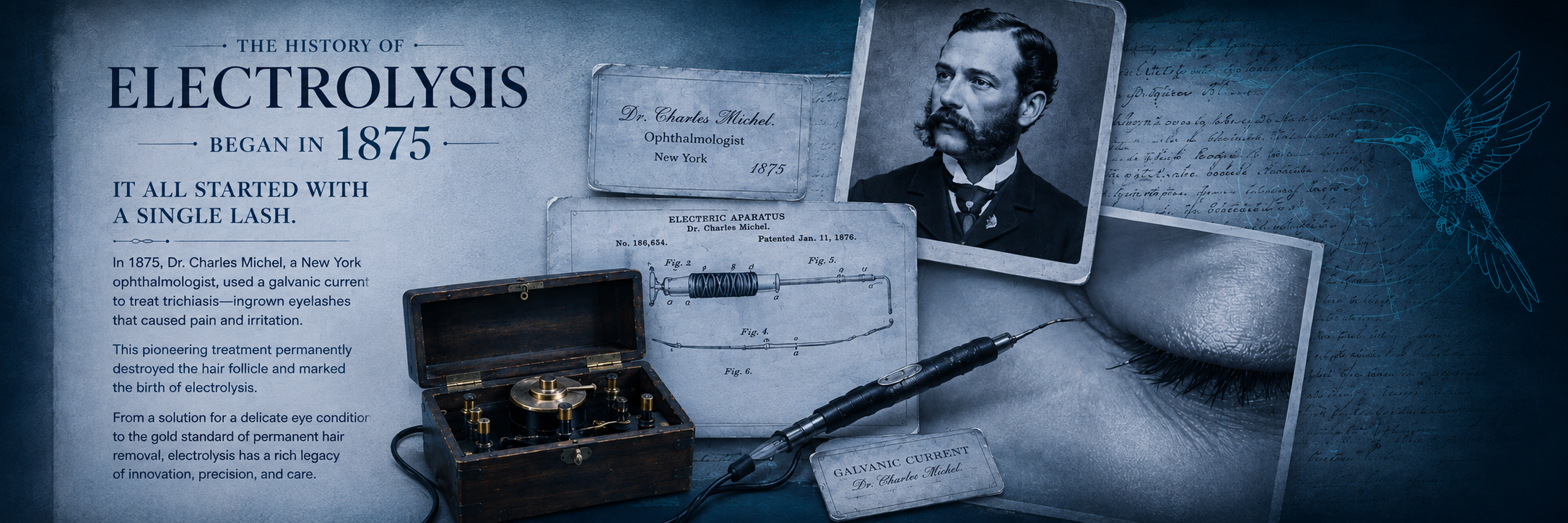
Ophthalmologist Dr. Charles E. Michel introduced electrolysis to the medical community after successfully treating ingrown eyelashes using electrical current. His published findings demonstrated that unwanted hair could be permanently destroyed, making him widely recognized as the pioneer of modern electrolysis. Dr. Michel also encouraged the use of the technique to remove unwanted hair from other areas of the body, and electrolysis expanded beyond ophthalmology as physicians begin adapting the technique for unwanted hair.
1916
Galvanic Electrolysis Becomes Practical
Professor Paul M. Kree developed the multiple-needle technique, making galvanic electrolysis a more practical solution for treating larger areas of unwanted hair. This advancement significantly improved treatment efficiency and expanded the accessibility of permanent hair removal.
1923
The Birth of Thermolysis
In Paris, France, Dr. Bordier introduced the use of high-frequency alternating current (AC) for permanent hair removal. This technique, known as Thermolysis, offered significantly faster treatment times than traditional galvanic electrolysis. Today, thermolysis remains the most commonly performed electrolysis modality because of its speed and precision, though treatment effectiveness continues to depend on the individual's hair characteristics and the electrologist's expertise.
1948
The Blend Method Changes the Profession
Inventor Henri E. St. Pierre, working alongside engineer Arthur Hinkel, patented equipment that combined the advantages of both Galvanic and Thermolysis into a single treatment. Known as the Blend Method (or Dual-Action Electrolysis), this innovation allowed electrologists to effectively treat even coarse, deep, and distorted follicles with greater precision.
Arthur Hinkel developed the tapered probe to improve current distribution within the follicle while reducing unnecessary skin trauma. The design allowed effective treatment with lower current intensity and helped reduce post-treatment scabbing compared with earlier straight probes.
1952
Improved Needle Designs
In 1952, dermatologist Dr. H. C. Goldberg published Newer and Proposed Electrolysis Needles describing advances in probe materials and geometry.
He specifically discussed platinum-iridium probes, thinner diameters, shorter probe lengths, greater flexibility, improved insertion accuracy and reduced follicular trauma.
These improvements significantly increased practitioner control and client comfort.
1968
The Landmark Textbook
One of the most important—but least appreciated—events was publication of Hinkel & Lind's book: Electrolysis, Thermolysis and the Blend
This textbook standardized treatment principles and became the educational foundation for modern electrology. It also formalized Hinkel's treatment-energy concepts, helping bring greater scientific consistency to the field.
1976
Electrolysis Become Subject to FDA Regulations Framework
The FDA had some federal authority over medical devices under the 1938 Federal Food, Drug, and Cosmetic Act. However, the modern regulatory framework for electrolysis equipment comes from the Medical Device Amendments of 1976, signed into law on May 28th. Those amendments created a Class I, II, and III device system, expanding FDA authority over medical devices. With the passage of the Medical Device Amendments, electrolysis equipment became subject to the FDA's medical-device regulatory framework. Today, needle-type epilators used for electrolysis are regulated as Class I medical devices.
FDA records electrolysis devices specifically for permanent hair removal, but, FDA-cleared laser devices are described in terms of permanent hair reduction, which they define as a long-term stable reduction in the number of regrowing hairs. Therefore, while you will not find a statement that specifically states electrolysis is the only FDA approved method of permanent hair removal, it is classified as such given the equipment used to administer it.
FDA — History of Medical Device Regulation »
FDA — Needle-Type Epilator Classification »
1985
Insulated Probes
This is actually when insulated probes became a documented innovation.
Dr. Toshio Kobayashi published clinical work demonstrating insulated needles for thermolysis. The insulation concentrated energy at the tip of the probe, reducing heating of upper tissue while maintaining effective follicle destruction.
Today
Continuing a Tradition of Permanent Results
Modern electrolysis combines more than a century of scientific advancement with computerized technology, precision instrumentation, and evidence-based treatment protocols. While equipment has evolved dramatically, the underlying principle remains unchanged: permanently destroying the hair-producing cells within the follicle so the hair cannot grow again.
Electrolysis continues to play an important role in treating hormonal hair growth, gender-affirming care, medically complex cases, tattoo preparation, and hair colors and skin tones that other technologies cannot reliably address. Ongoing advances in computerized equipment, precision optics, and practitioner education continue to improve comfort and treatment outcomes.
Unlike temporary hair removal methods—or technologies that offer only permanent hair reduction—electrolysis remains the only method recognized by the U.S. Food and Drug Administration (FDA) as permanent hair removal. Its effectiveness across all skin tones, all hair colors, and nearly every area of the body continues to make it the gold standard for permanent unwanted hair removal.
Science You Can Trust
At Electrolysis Beauty Lounge, we believe understanding the science behind electrolysis empowers you to make informed decisions about your care. More than 150 years after its introduction to medicine, electrolysis continues to provide a safe, effective, and proven solution for individuals seeking permanent hair removal.